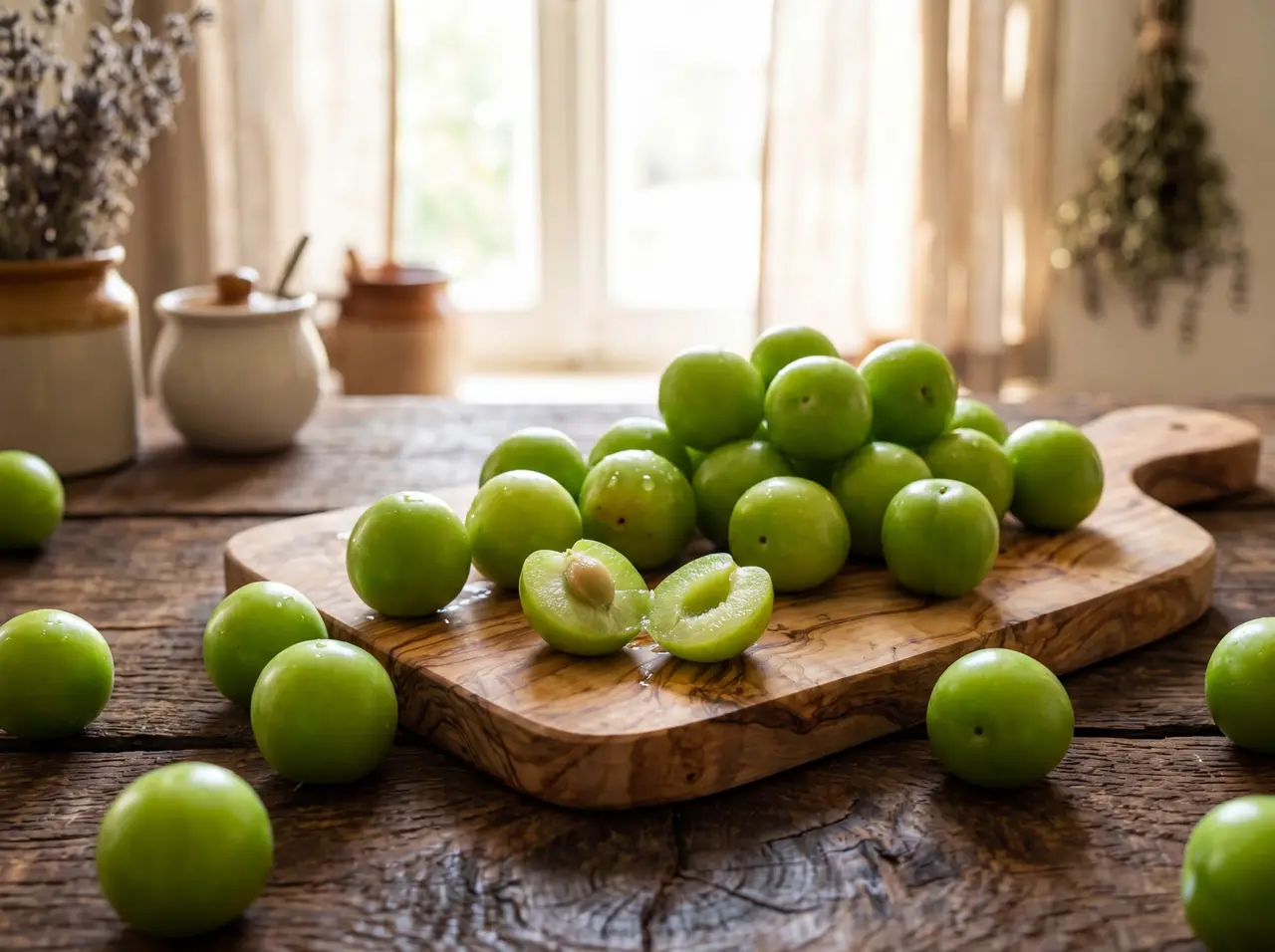
Janerik: Lebanon's Sour Green Plum
Small, crisp, and aggressively sour — this spring street snack is one of Lebanon's most fleeting pleasures.
A Plum Before Its Time
Most fruits are picked when they're ready. Janerik is picked before it's ready — and that's the whole point.
Janerik (Prunus domestica) are unripe green plums, harvested in March and April while still small, firm, and loaded with tartaric acid. They won't become the deep purple plums you'd find at a European market. In Lebanon, they never get the chance. The window to pick them at peak sourness lasts only a few weeks, and the entire country seems to be waiting for it.
Known in Arabic as جانرك (janerik), these small green orbs — roughly twice the size of a grape — are about as sour as fruit gets. That sourness is the draw. It's sharp, clean, and oddly addictive in a way that sweet fruit rarely is.
Why Lebanon Grows Them
The Lebanese mountains, with their limestone soils and dramatic temperature swings between winter and spring, produce conditions that suit stone fruit perfectly. Plum trees have been cultivated across Mount Lebanon and the Chouf for generations, their fruit destined not for ripening but for early harvest.
The practice of eating green, unripe plums is ancient across the Levant — documented in Ottoman-era food traditions and referenced in classical Arabic poetry. What sets Lebanese janerik apart is the combination of altitude and soil chemistry, which produces a tartness that's more complex than simple acidity: there's a faint sweetness underneath, and a floral note that disappears completely if the fruit is left on the tree.
This is hyperlocal produce in the truest sense. Janerik doesn't travel well. It doesn't ship to Europe or the Gulf in the same form. It belongs here, in season, eaten the same day it's picked.
The Flavor and Why It Works
Biting into a janerik is a commitment. The skin snaps cleanly. The flesh is dense and juicy — not the soft give of a ripe plum, but the firmness of a green apple. The sourness hits immediately and runs all the way to the back of your jaw.
And then you reach for another one.
The classic way to eat janerik is with a pinch of coarse salt. This isn't garnish — the salt counterbalances the acidity and brings out the fruit's faint sweetness in a way that transforms the whole experience. Street vendors in Beirut sell them in small paper bags, salted to order. You eat them standing up, usually in minutes.
Some people add a dusting of dried chili. The combination of sour, salty, and spicy is one of those flavor combinations that makes total sense once you've tried it and seems inexplicable until you do.
Cultural Moment
Janerik season is a social marker. When green plums appear at street carts and produce stalls, it means spring has genuinely arrived — not meteorologically, but culinarily. School children eat them on the walk home. Office workers buy a bag to share. Families argue about whether this year's batch is sourer than last year's.
There's no janerik dish, exactly. No famous recipe that showcases them. They're not cooked or preserved or transformed. They exist almost entirely as a fresh eating experience — a kind of seasonal punctuation in the Lebanese food calendar.
This is both their charm and their limitation. Janerik don't fit into any category except "right now."
Nutrition
Unripe green plums are nutritionally dense in ways their ripe counterparts aren't. Janerik are high in vitamin C — the acidity you're tasting is partly ascorbic acid — as well as dietary fiber, antioxidants, and malic acid, which supports digestion. Traditional Lebanese folk medicine has long used green plums as a digestive tonic, and the science broadly supports this.
They're also low in sugar compared to ripe fruit. The sugars haven't fully developed yet, which is part of why the sourness is so dominant. For anyone watching glycemic load, janerik are one of the more virtuous spring snacks available.
How to Buy and Store
Look for janerik that are uniformly green — no yellow tinge, which signals the fruit is starting to ripen and losing its peak tartness. They should be very firm, with tight, unblemished skin. Avoid any that feel soft at the tip.
Storage is simple: janerik keep well in the refrigerator for 3-5 days without losing much quality. Don't wash them until you're ready to eat — moisture accelerates softening. At room temperature, they'll ripen quickly; if you want to extend their sour window, keep them cold.
Buy what you'll eat within the week. Janerik aren't a fruit to stock up on.
Frutzco and Janerik
We source janerik directly from orchards in the Chouf and Mount Lebanon during the short March-April window. Our growers harvest to order — picked in the morning, delivered the same day wherever possible. When janerik appear in our catalog, the season is live and moving fast.
Order early in the week. This is not a fruit that waits.
---
Janerik season is measured in weeks, not months. Check the catalog.