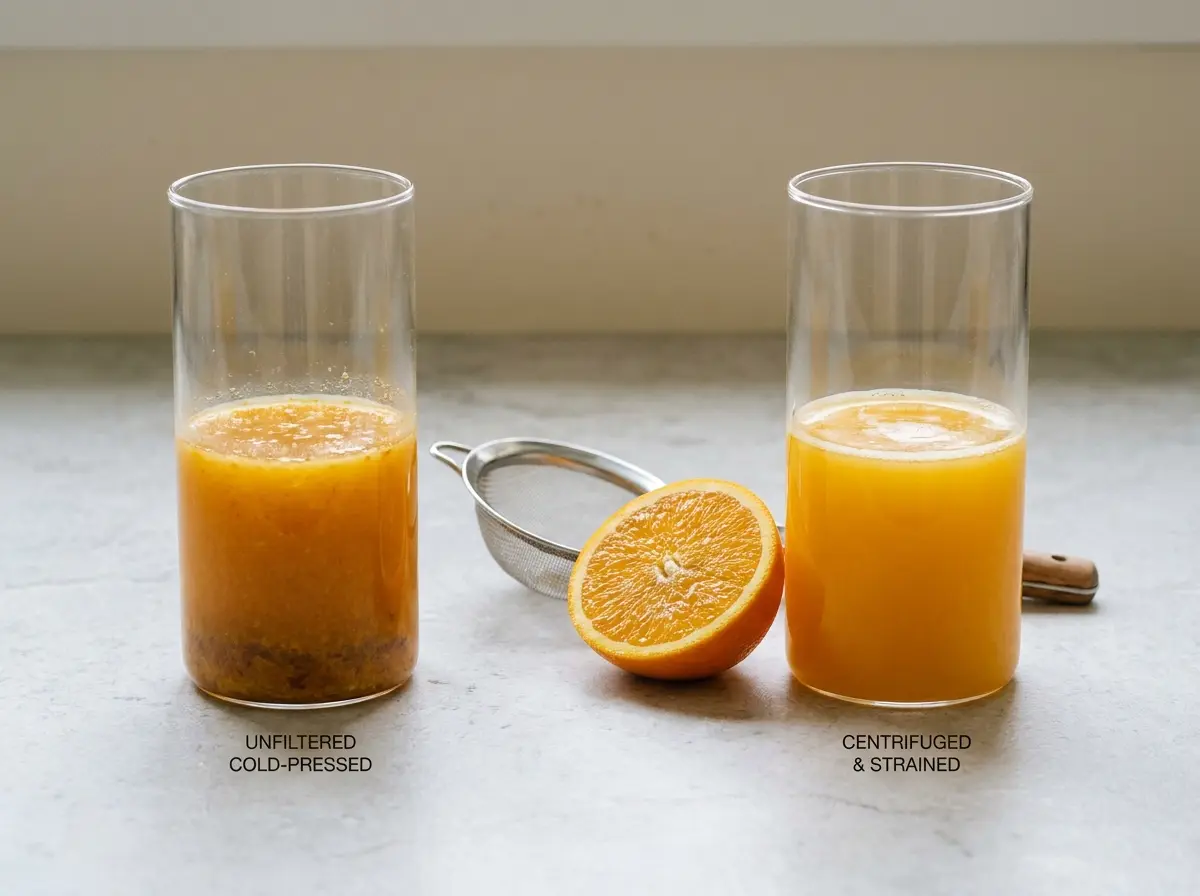
Cold-pressed vs centrifuged juice: the difference is real, and one of them costs the other a lot
Why the same orange juice looks completely different depending on how you extract it
The conventional wisdom
Walk into any juice shop or read any wellness blog and "cold-pressed" gets used as shorthand for "high-quality juice." The implication: any juice not heated is cold-pressed. This is wrong. Most home juicers — and most juice bars in Lebanon — use centrifugal extractors, which are not cold-pressed even though they don't apply heat. The mechanical difference matters more than the temperature label suggests.
What cold-press actually means
Cold pressing uses a hydraulic press: produce is ground into a pulp, wrapped in a cloth filter, and squeezed under hydraulic pressure (1-2 tons of force) for several minutes. The juice is extracted slowly through the filter cloth, and the pulp is discarded as a dry cake. No spinning, no heat, no air exposure.
Centrifugal extraction — what most counter-top juicers do, and what most juice bars use — shreds the produce with a fast-spinning blade and spins the resulting liquid out through a mesh basket. The juice extraction takes seconds, not minutes, and the process aerates the juice significantly. The pulp comes out wet because the centrifuge can't extract every drop.
What changes between the two
Yield: a hydraulic press extracts roughly 30-40% more juice from the same weight of produce. Cold-pressing 1 kg of apples gives about 700ml of juice; centrifuging gives 450-500ml.
Shelf life: cold-pressed juice keeps 3-5 days refrigerated; centrifuged juice should be drunk within 24 hours. The centrifuge whips air into the juice, which accelerates oxidation. You'll see this visually: centrifuged juice often separates into a watery bottom and frothy top within hours, while cold-pressed juice separates more slowly and gracefully.
Taste: cold-pressed juice is more concentrated and slightly less aerated, which makes it taste richer and less acidic. Centrifuged juice has more dissolved air and more pulp particulate, which can feel "fresher" in the moment but fades faster.
Nutrition: research shows cold-pressed juice retains more vitamin C (about 20-30% more in apple and orange juice) and more polyphenols because of the lower oxidation exposure. The difference is real but moderate, not the night-and-day claim some marketing makes.
Bonus trick: spot a real cold-pressed juice
Three quick tests at the shelf:
- Hold it up to light. Real cold-pressed juice is slightly cloudy with visible suspended pulp particles that settle to the bottom over time. Clear, uniform-color juice is almost certainly centrifuged-and-strained or made from concentrate.
- Check the shelf life. Anything labelled "cold-pressed" with a 30-day shelf life has been HPP'd (high-pressure pasteurization) — not heat-treated, but compressed at 80,000 psi to kill bacteria. HPP changes the texture and nutrient profile in ways neither labelling nor most reviewers acknowledge. True raw cold-pressed lasts 3-5 days.
- Shake it. Real cold-pressed juice settles into layers within 24 hours. If you shake the bottle and the juice instantly becomes uniform with no resistance, it's been homogenized or it's a thin centrifuged juice diluted with water.
Why this works
Centrifugal force operates radially: the blade slashes the produce, spinning fragments fly outward, and juice escapes through the mesh while heavier pulp packs against the basket wall. Air gets entrained in this whole sequence, oxidizing the juice on contact. The hydraulic press, by contrast, applies force linearly across the cloth bundle, with no spinning and minimal air exposure. The slower extraction also means the cellular structure of the fruit isn't violently torn — the juice that comes out is closer to what was inside the cell, not the result of an emulsion-and-tear with air.
Both methods give you juice. They give you different juice.